McDonald’s Is Phasing Out Soda Fountains – And It Points to a Far Bigger Change on the Horizon
Walk into most McDonald’s restaurants today and you’ll likely notice something missing from the dining room. Those familiar self-serve beverage stations where customers have filled their own cups for decades are vanishing. It’s not just a minor tweak to the layout. This shift signals something much larger brewing beneath the surface of the fast food industry.
The decision might seem trivial at first glance. Yet the removal of these fountains represents a fundamental rethinking of how McDonald’s interacts with diners, and honestly, it reveals where the entire restaurant sector is heading in an increasingly digital world.
The Timeline Is Already Underway
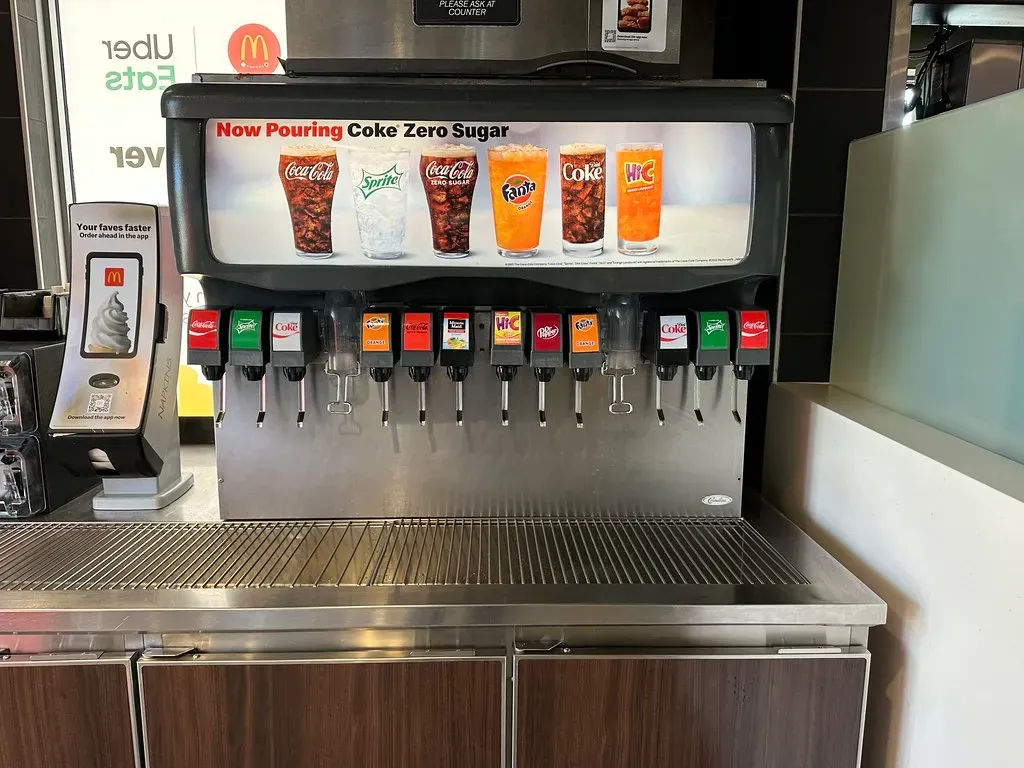
McDonald’s announced it will slowly remove self-serve beverage stations from all U.S. locations by 2032. That might sound like a distant deadline, yet the process is already well underway across the country. Several restaurants in Illinois have already made the change, and locations in various other states have followed suit.
These self-serve beverage stations have been a staple of McDonald’s dining rooms since 2004. For nearly two decades, customers enjoyed the freedom to fill their own drinks, control ice levels, and mix flavors to their heart’s content. That era is closing.
Why This Change Matters Beyond Your Cup
The change is intended to make customer experiences consistent no matter where you order, whether on the app, in the drive-thru, in the restaurant or through other methods. Let’s be real, this explanation sounds nice on paper. The reality runs deeper than simple consistency.
Even before the pandemic, more than two-thirds of McDonald’s business came through the drive-thru, and that has only increased since. The dining room is becoming less relevant to the company’s core operations. With fewer dining room customers and remodels featuring smaller dining rooms, operators are having a harder time justifying the need for a drink station.
This shift exposes an uncomfortable truth about modern fast food. The in-person dining experience is quietly being deprioritized in favor of speed-focused channels that generate higher volume.
The Digital Transformation Driving Everything
McDonald’s digital sales, made up of app, delivery and kiosk purchases, accounted for almost 40% of systemwide sales for the second quarter of 2023. Think about that proportion for a moment. Nearly half of all transactions now happen through screens rather than face-to-face interactions.
The MyMcDonald’s loyalty program now boasts 185 million active users across 60 markets, and in the U.S., loyalty members more than double their visits in the first year. The company has invested heavily in technology, partnering with Google to deploy advanced systems across thousands of locations. Edge, their computing platform developed with Google, extends cloud capabilities directly into restaurants and is now live in hundreds of U.S. locations, powering AI and IoT-enabled kitchens that are smarter, faster, and more reliable.
This technological backbone enables innovations like predictive maintenance, automated order accuracy checks, and geofencing that alerts staff when mobile customers approach. The soda fountain removal fits perfectly into this broader digital ecosystem where crew members handle all beverage service behind automated systems.
What Customers Actually Lose
Without the stations, customers may not be able to enjoy the experience of mixing and matching drink combos, and although McDonald’s says this allows too much variation in the overall beverage experience, customers are already saying they’ll miss this particular perk. The ability to customize drinks precisely, control ice ratios, and get refills without waiting represented a small but meaningful piece of autonomy.
Without the drink dispensers, in-restaurant customers can’t pour themselves their own drinks, and individual franchises have the power to decide if they will charge for refills. That last part matters enormously. Free refills may disappear at some locations entirely, transforming what was once a value proposition into an additional cost.
There’s also the environmental angle. Many locations won’t refill your existing cup for sanitary reasons, so instead you’re handed a new cup with a fresh drink, meaning the old cup goes straight to the garbage. The irony is striking. A change framed around modernization and cleanliness could actually generate more waste than the system it replaces.
The Industry-Wide Shift This Represents
Darren Tristano, CEO of Foodservice Results, said he thinks other fast food chains will follow McDonald’s lead, noting that McDonald’s is a leader and most other fast food chains are fast followers. This pattern has played out repeatedly throughout fast food history. When the industry giant makes a move, competitors typically follow within months or years.
Fast-food companies are embracing new technology to automate tasks and speed up production as customers demand faster and more convenient service, and restaurants are adapting. Chick-fil-A has tested digital-only concepts. Wendy’s is automating drive-thru ordering with AI. Panera experimented with digital-only restaurant formats. The entire sector is recalibrating around off-premise dining and technology-driven efficiency.
The removal of self-serve fountains represents more than operational streamlining. It symbolizes the transformation of fast food from a place you visit into a service you access through multiple channels, most of which don’t involve sitting down at all. The physical restaurant is becoming less of a destination and more of a fulfillment center for digital orders.
What we’re witnessing is the quiet redefinition of what fast food actually means. Speed and convenience have always been core values, yet now they’re being optimized to such an extreme degree that the traditional dine-in experience is being redesigned or eliminated entirely. Your local McDonald’s in 2026 will look and function very differently than it did just a few years ago. Did you expect the humble soda fountain to be the symbol of that transformation?