8 Vintage Pyrex Patterns Worth Serious Money Today
A one-quart casserole donated to Goodwill of Western New York sold at the charity’s online auction in 2017 for $5,994, after 60 bidders went head to head over it.1 Common patterned Pyrex typically sells for a few dozen dollars, so something about that little dish was very different.
The eight patterns below run from a few hundred dollars to several thousand, and every figure is a range, because condition, lids and sellers all move the number. Some were test pieces, some were party-plan prizes, and one was reportedly meant only for people who worked at Corning. The best known of them even has a modern reissue that resells for about $20 to $60, which says a lot about where the money comes from.
#8 – Orange and Pink Amish Butterprint
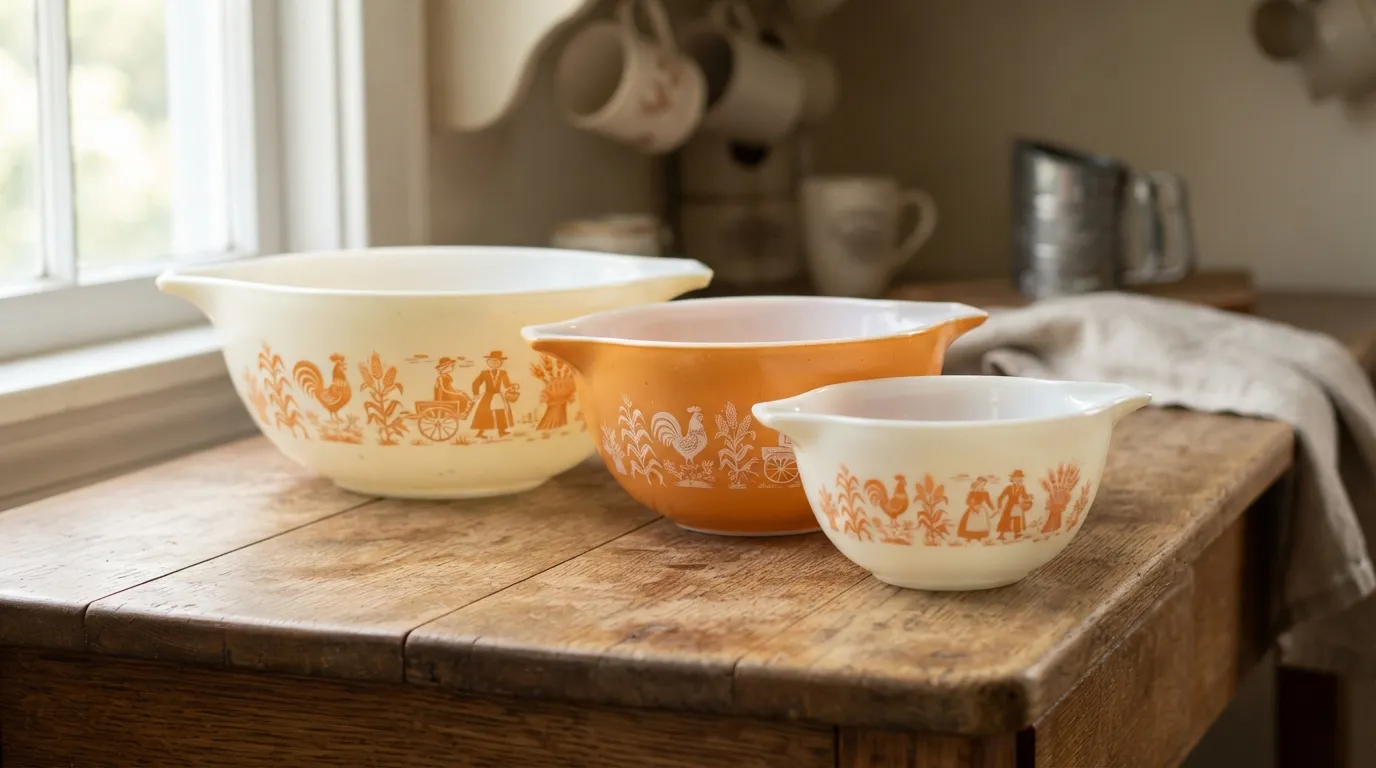
Butterprint is a stylized farm scene, with corn stalks, roosters, wheat sheaves, and a farmer and his wife in an Amish-style print. The Corning Museum of Glass dates it from 1957 to 1968 and calls it one of the first printed patterns on opal Pyrex.2
The version you are most likely to meet is turquoise on white, or white on turquoise. The museum notes that promotional sets in orange and pink on white, and white on pink, were released in the late 1950s and early 1960s, and those are the colors collectors pay extra for.2
Published estimates for orange Butterprint run from about $175 to $300 at the low end to $2,000 at the high end, so the market has not settled on one number. I would not buy turquoise Butterprint as an investment, because it is the color that filled the shops.
Three quick checks help you tell a promising dish from a common one:
- Read the base: all-caps PYREX points to a vintage piece, and lowercase generally points to something newer.3
- Look at the color of the print, since orange and pink are the premium colorways.
- Ignore the three-digit number on the bottom. It is a shape and size code, not a date.
Butterprint shared the new Cinderella nesting bowls with a second early pattern, a berry-and-leaf design that often gets mistaken for grape leaves.4
[article_quiz]#7 – Pink Gooseberry Cinderella Bowl Sets
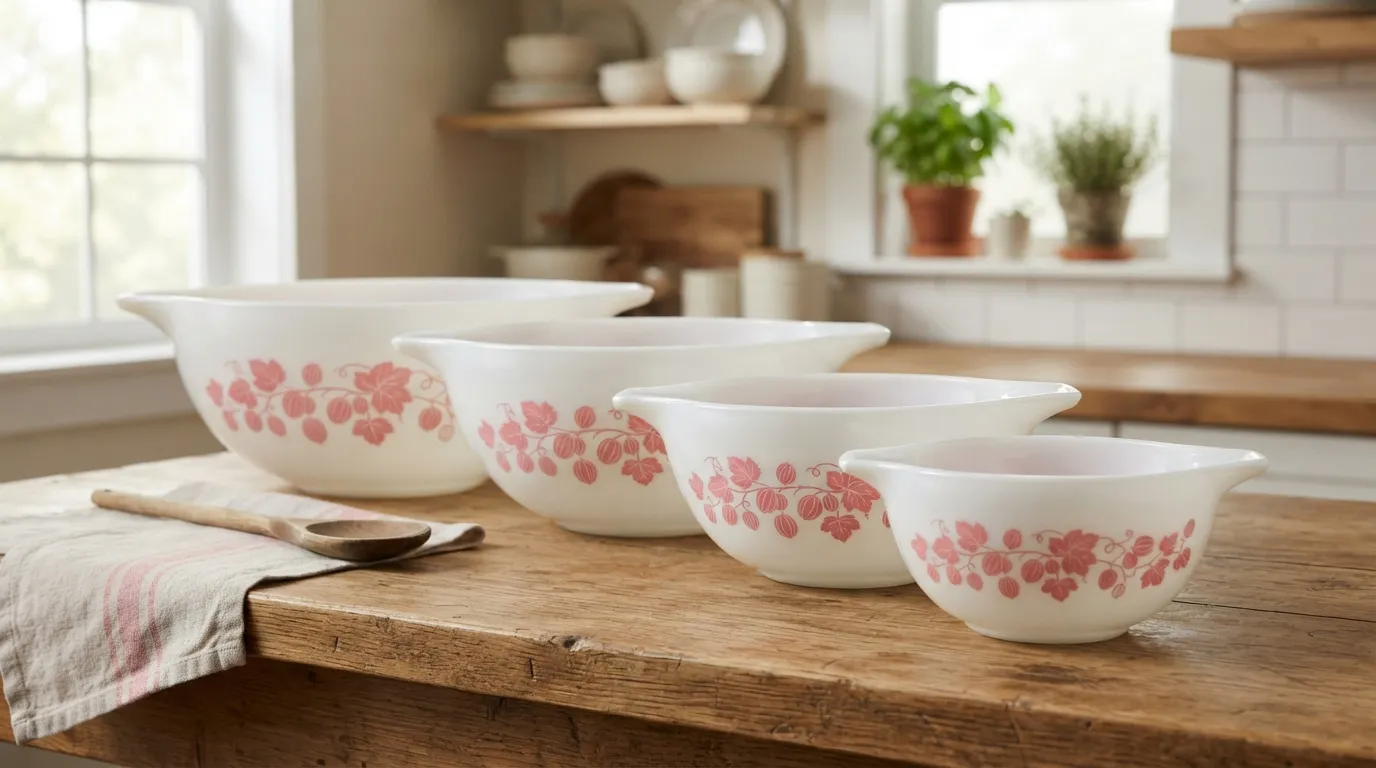
Gooseberry was made from 1957 to 1966, with a fruit and leaf design in several color combinations. Plenty of people call it “Grape Leaves” at first glance, and it is an easy mistake to make.
It appears most often on Cinderella bowls, the ones with pouring spouts on two sides, and pink on white is the combination buyers search for. Because it had a full production run, it does not match the prices of the rarest test and promotional pieces, though pristine sets can still be valuable.
Reader’s Digest reported that a three-piece Pink Gooseberry mixing-bowl set recently sold for $360, compared with up to $1,000 for a complete set of four. That jump is why I would hold out for the full matched four and skip the lone bowl, since complete sets in matched condition are harder to find than single bowls.
Quick Compare
- Three-piece set: a recent reported sale of $360.
- Complete matched set of four: up to $1,000.
- Lone bowl: easier to find, so harder to price high.
Before you pay, look for these flaws:
- Chips around the rim and the spouts.
- Fading of the pink print, which shows when you tilt the bowl in the light.
- A white film on the glass, which indicates dishwasher damage.
A nine-year production run is what keeps Gooseberry sets findable, and it is exactly what separates them from a design that was sold for only a single year.
#6 – Barcode, the One-Year Stripe
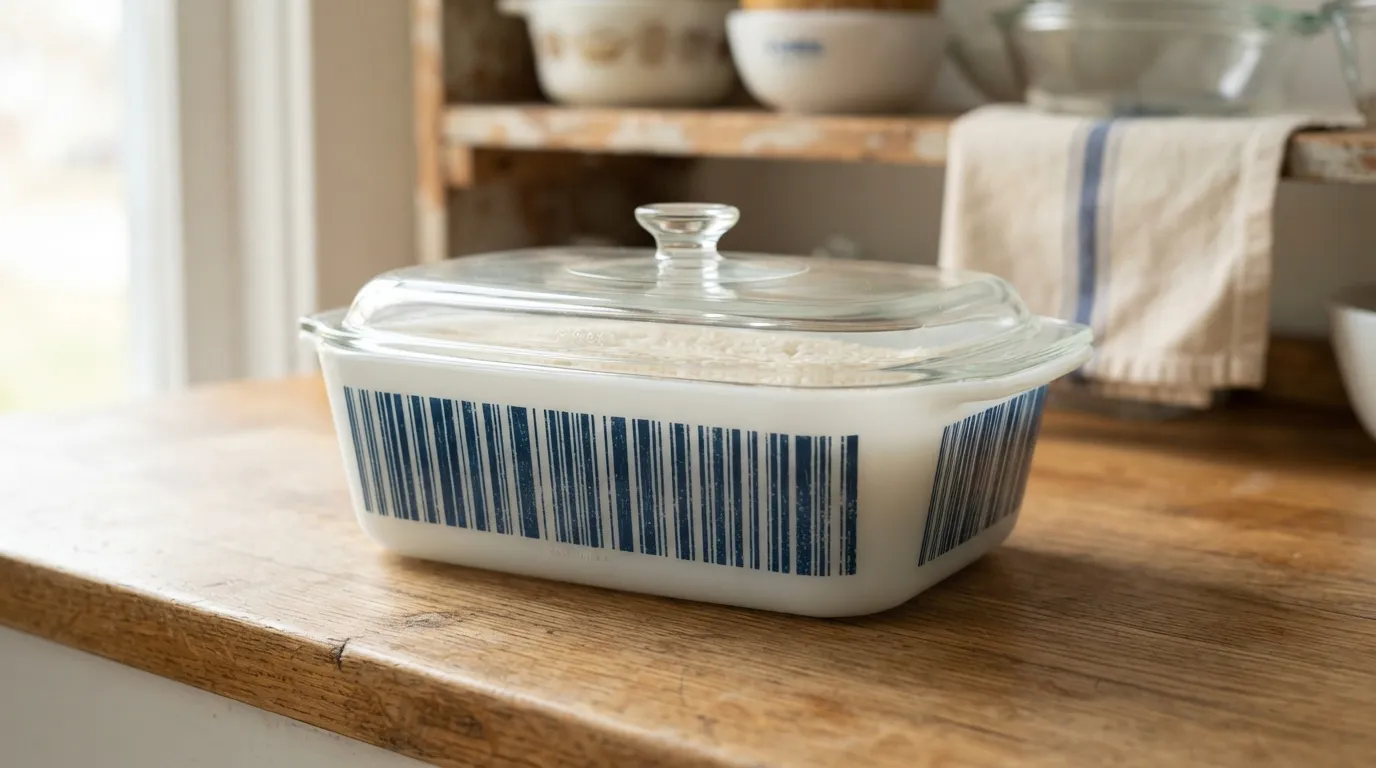
Collectors call it Barcode, but the official name was Blue Stripe, and the nickname stuck. The pattern was produced for just one year, 1966.
It appeared only on promotional items or test pieces. The blue colorway is the most common of the group, so a dish in the usual denim blue is the version you will meet first.
The rarer colors are where the money is. At least eight other color combinations, originally marketed as gift sets for holidays and other special dates, have been tracked down.
Prices follow color closely. One older list put Blue Stripe at $50 to $300, while a more recent chart lists the orange version at $1,000 to $3,000, which is the same kind of scarcity that sets orange Butterprint apart from turquoise, only more extreme.
#5 – Atomic Eyes Chip ‘n’ Dip Sets
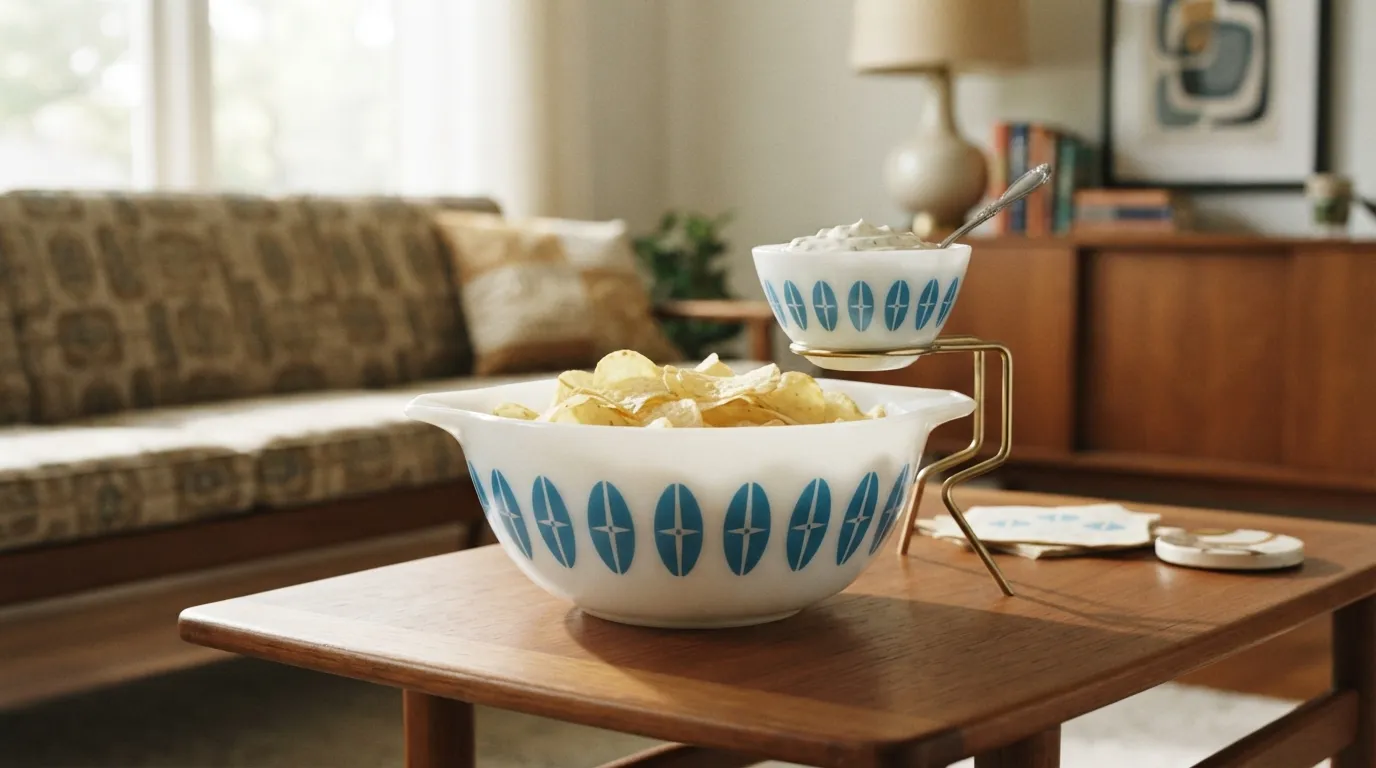
Atomic Eyes is a white set decorated with blue oval “eyes” and crosses at the center. It is a midcentury pattern that was released as a chip ‘n’ dip set, the kind of thing that once sat on a snack table beside a bowl of onion dip.
It turns up on more than bowls. The Corning Museum of Glass says the Eyes pattern also appeared on a coffee carafe and a clear one-quart juicer with a turquoise plastic lid, and collectors hunt for those odd companions.
One appraisal guide puts single pieces at $400 to $1,500, and complete sets are described as potentially worth hundreds to thousands of dollars. That is enough that a chip ‘n’ dip set priced like ordinary kitchenware deserves a closer look.
Worth Knowing
- The pattern is not limited to bowls, so check cupboards for a carafe or a juicer.
- The juicer is clear glass with a turquoise plastic lid.
- Single pieces and full sets are priced very differently, and both ranges are wide.
Check that every lid and every piece is there before paying a collector’s price, because a set with missing parts is a different purchase. Atomic Eyes was at least a pattern the public could buy, whereas some of the rarest dishes in Pyrex collecting were test pieces that never became a full line.
#4 – Black Star Test Pieces With Colored Lids
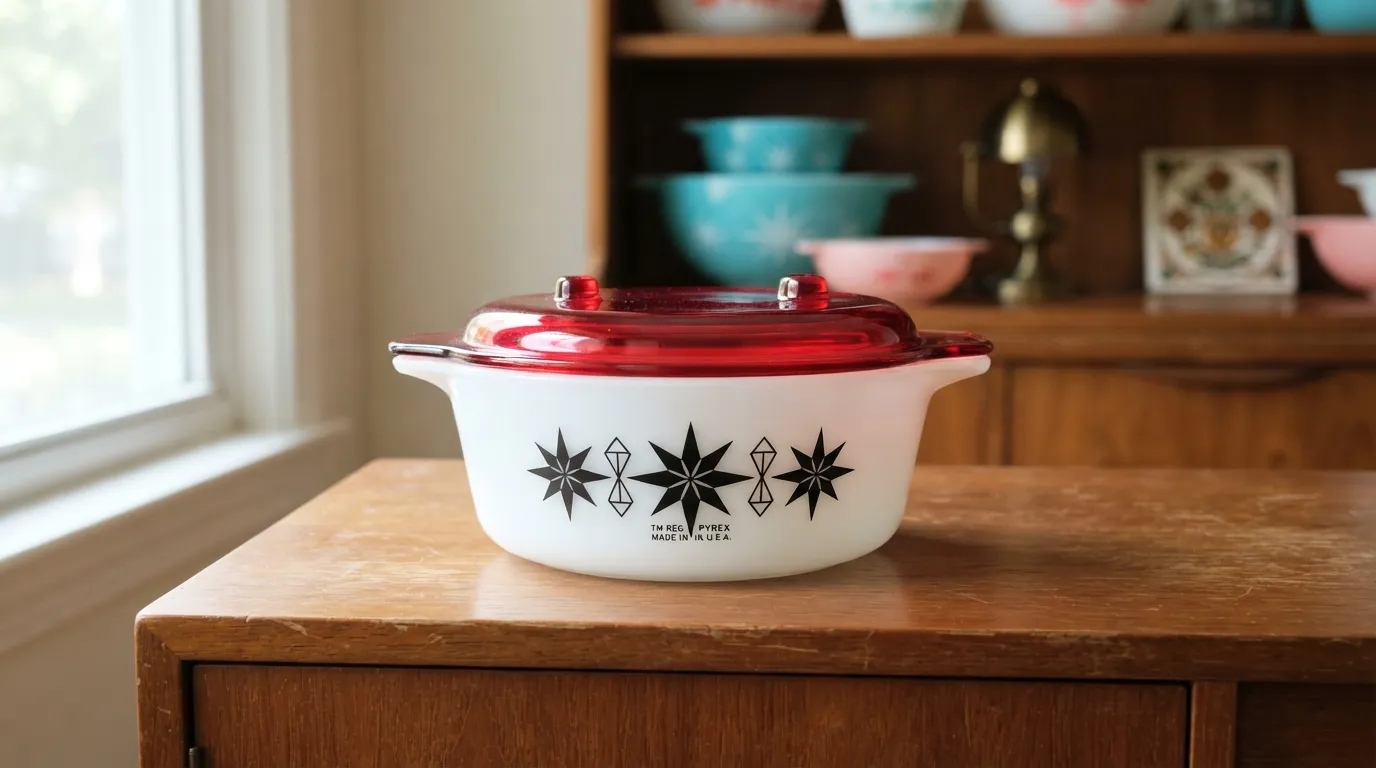
Black Star was a 1950s test piece. It featured an eight-pointed star in matte paint on an opal dish, paired with matching lids in green, red, and pink.5
Because it was only a trial, few dishes were made, and the lids matter a great deal. A list republished by AOL says having the lids increases the value significantly, with an estimate of $2,500 to $6,000.5
Starburst shows the same split. The Turquoise Starburst went into production, but the Black and Peach version was likely a test piece, and that list estimates it at $4,000 or more.6
Lids lifted the price of a Black Star, yet that is a small matter beside a pattern whose lid came with its own warming stand.
#3 – Pink Duchess With Its Warming Stand
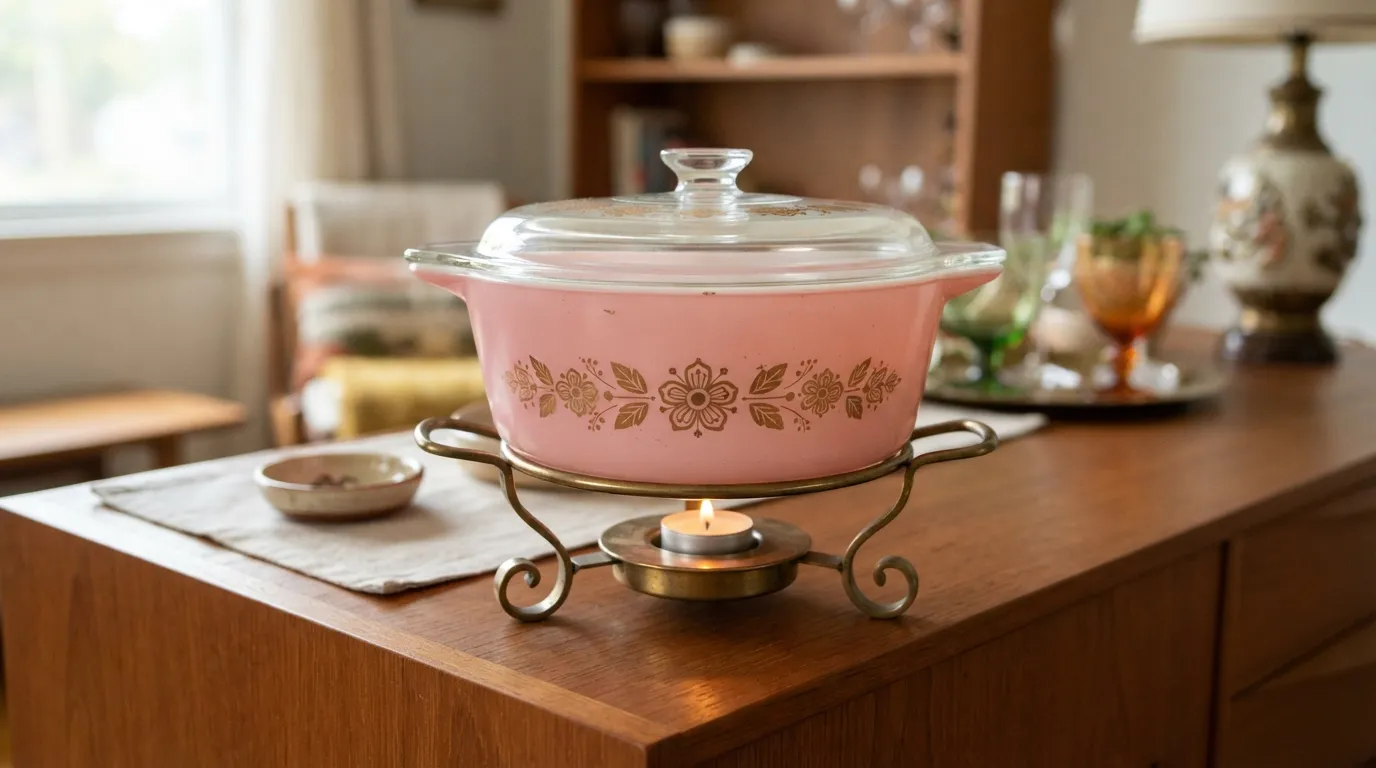
The Duchess set was produced in 1959 in collaboration with Stanley Home Products as part of the company’s Hostess Party premium deals. It was a reward for hosting a party, not something you picked off a store shelf.
The star of the set is a round casserole in pale pink with a delicate gold flower pattern, a clear glass lid and a warming stand. House Digest reports that the casserole set can go for as much as $3,000 on eBay.
Another chart lists Pink Duchess at $2,000 to $4,500 or more, and says complete sets, with all three components, are rare and valuable.6 So a pink casserole without its lid and stand is a partial set, and you should price it as one.
The Duchess at least reached ordinary kitchens through a party plan. The next casserole is believed to have skipped the public entirely.
#2 – Turquoise Golden Birds Space Saver Casserole
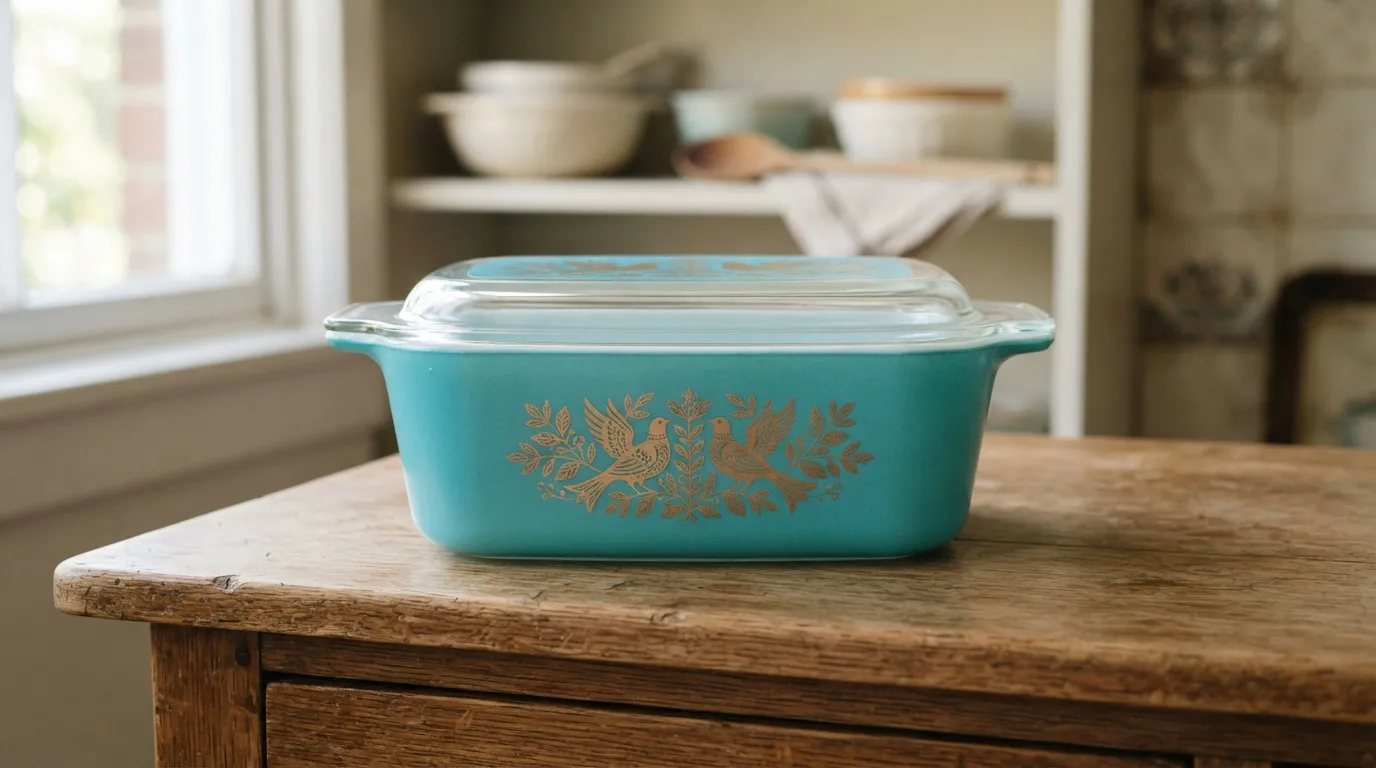
This is a space saver casserole in turquoise, with a gold leaf pattern featuring two birds at the center. You are unlikely to find it in a store catalog, because it was not sold in one.
It is believed to have been made exclusively for Corning Glass Works employees and never released to the public. Very few are in circulation, and the ones listed for sale carry price tags in the thousands.
One widely republished list estimates it at $6,000 to $7,000, and a matching lid adds to the value. Two sales of about $6,000 each are reported as the most expensive Pyrex ever sold on eBay.
Why It Stands Out
- It is believed to have been made only for Corning Glass Works employees.
- It was never sold through a store catalog.
- Estimates of $6,000 to $7,000 sit above every other pattern on this list so far.
- The matching lid adds to the value.
That insider-only history shows in the estimates, which sit well above the Duchess. With a price like this, ask for clear photos of the base, the print and the lid before you trust a seller’s story.
#1 – Lucky in Love, the 1959 Casserole
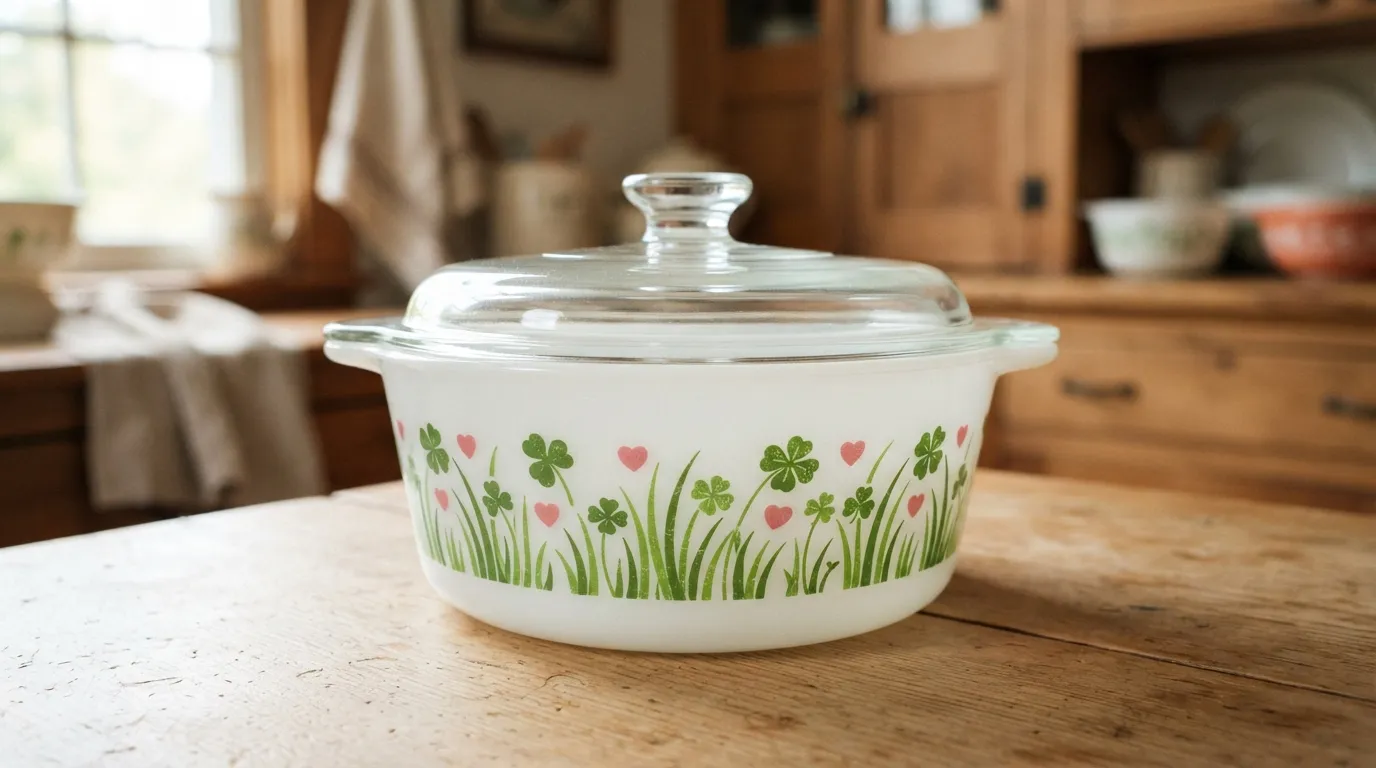
The Corning Museum of Glass dates Lucky in Love to 1959 and calls it most likely a test piece or a limited release, printed on the one-quart round casserole. The design has green grass, four-leaf clovers and pink hearts.
It is the dish behind that Goodwill sale. The 2017 auction closed at $5,994 after 60 bidders competed, and the museum notes online sales of over $4,000.1 3
Estimates vary with who is counting. An authenticated example can fetch from $4,000 to more than $5,000 at auction, depending on condition and the intensity of its coloration, and one dealer’s estimate runs above $10,000.
Quick Compare
- The 1959 original: a one-quart round casserole, most likely a test piece or limited release, with authenticated examples from $4,000 to more than $5,000 at auction.
- The 2018 re-release: clear glass storage dishes with no pouring spouts and plastic lids, reselling for about $20 to $60.
Faded hearts, a replaced lid or gray utensil marks cost a dish much of that value, and the headline prices have drawn lookalikes, so buyers inspect the backstamp carefully. The print did not change between the two; what changed is that the original was a 1959 test piece or limited release.7
Read the Bottom of the Dish Before You Wash It
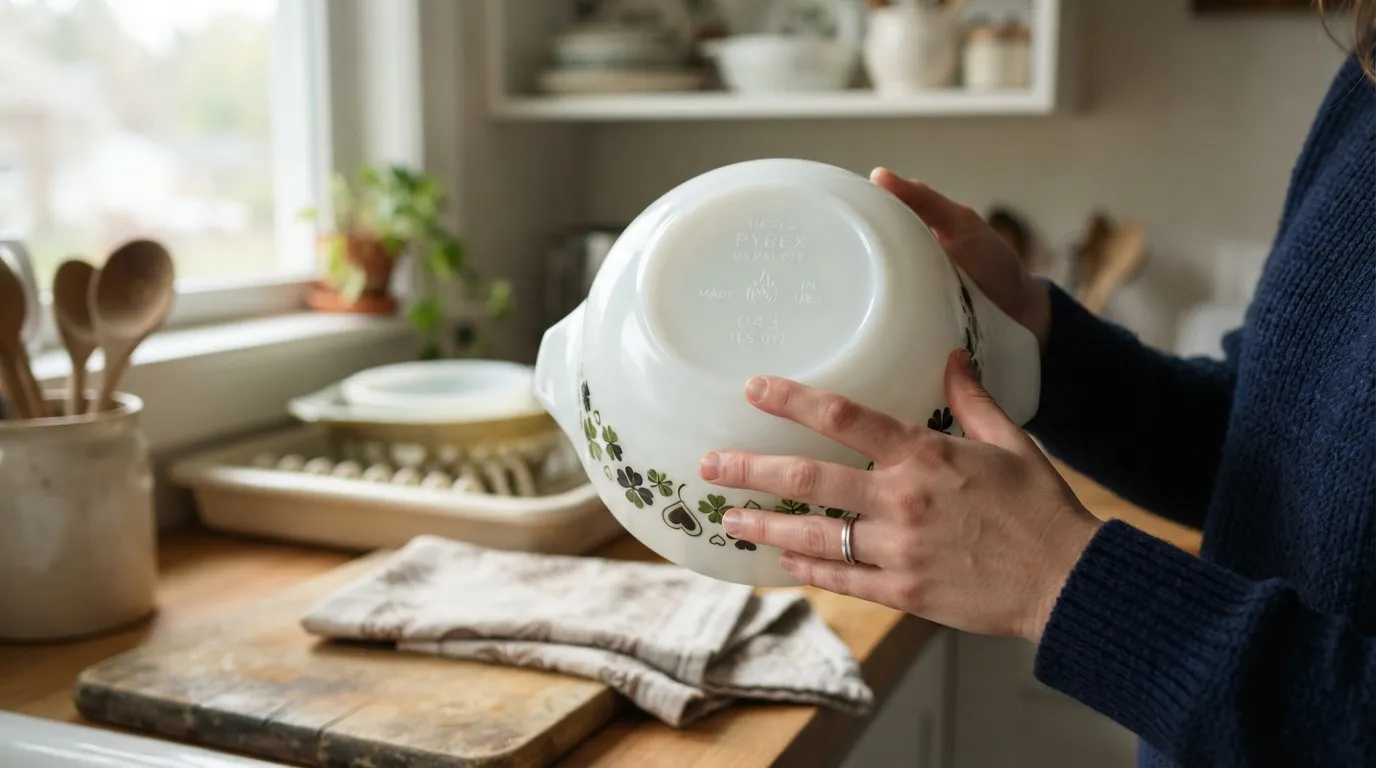
The dishes on this list share one trait: they were made for a reason other than being sold in volume. Promotions, party plans, employee gifts and test runs all produced pieces that were rare from the start, while a dish made by the millions stays modest in price no matter how old it is.
So the useful question for a cupboard find is who the dish was made for. Turn it over, read the base, match the print to a pattern library, keep the lids and wash by hand.
Is there a patterned Pyrex dish in your kitchen that came from a parent or grandparent, and do you know which pattern it is?
- Goodwill WNY Record Sale: https://www.goodwillwny.org/post/2017/08/15/holy-grail-of-pyrex-sells-for-record-price
- CMOG Butterprint Pattern: https://glasscollection.cmog.org/objects/42544
- Vintage Pyrex Value Guide: https://estimonia.com/guides/collectibles/vintage-pyrex-value-guide
- CMOG Butterprint Cinderella Bowls: https://glasscollection.cmog.org/objects/66598
- Valuable Pyrex Patterns List: https://www.aol.com/articles/most-valuable-pyrex-patterns-own-145137000.html
- Pyrex Patterns Value Estimates: https://shopping.yahoo.com/home-garden/kitchen/articles/most-valuable-pyrex-patterns-own-145137852.html
- Lucky in Love Overview: https://www.aol.com/lifestyle/double-check-cabinets-50s-pyrex-190000337.html