Possible U.S. Debt Spiral As Borrowing Costs Near Economic Growth, Watchdog Warns
The United States finds itself at a troubling crossroads as federal watchdogs sound alarm bells over the nation’s mounting debt crisis. The numbers are sobering, the trajectory unsustainable, and the timing particularly precarious. What was once a distant concern debated in policy circles has now become an immediate threat to America’s financial stability and economic future.
Here’s the thing, the federal government isn’t just spending more than it earns anymore. It’s spending so much more that the very cost of servicing the debt threatens to spiral out of control. Welcome to the world of fiscal danger zones, where interest payments devour resources faster than policymakers can plug budget holes.
Crossing the Threshold Where Borrowing Costs Approach Economic Output

The Congressional Budget Office’s forecast shows the economy will expand slower than its prior view, with nominal GDP growth cooling from 4.1% in 2025 to 3.9% in 2026 and 3.8% in 2027. Meanwhile, the average interest rate the Treasury Department pays is currently 3.316%, and CBO sees the rate rising to 3.4% this year and continuing to increase, reaching 3.9% in the final years of its projection period. This narrowing gap represents a potentially dangerous convergence point.
Let’s be real, when your borrowing costs start matching or exceeding the rate at which your economy grows, you’re in trouble. The rising average interest rate will account for about half of the increase in interest costs over the next decade. That’s a mathematical recipe for what economists call a debt spiral, where borrowing begets more borrowing just to cover the interest on existing obligations.
The Committee for a Responsible Federal Budget said in a note that “CBO’s latest baseline shows an unsustainable fiscal outlook, with debt approaching record levels, deficits remaining elevated at more than twice a reasonable target, and interest costs exploding”. These aren’t alarmist predictions from fringe commentators. They’re stark warnings from respected nonpartisan institutions.
Interest Payments Surpass One Trillion Dollars Annually

The federal government spent $1 trillion on interest payments in fiscal year 2025, which was $79 billion more than the $949 billion it spent in FY 2024. Think about that for a moment. A trillion dollars spent on nothing but interest. Not education, not infrastructure, not defense. Just servicing existing debt.
Net interest was the second largest government expenditure in FY 2025, behind only Social Security, and totaled nearly one fifth of all federal revenue collections. The federal government currently spends more on interest payments than it does on Medicare, national defense, Medicaid, veterans’ benefits and services, food and nutrition services, transportation, and science, space, and technology, among other federal programs. The magnitude of this shift in budget priorities can’t be overstated.
Over the FY 2026 to FY 2035 budget window, CBO estimates interest payments will grow faster than any other major budgetary category. Net interest will grow by 76 percent, rising from $1.0 trillion in FY 2026 to $1.8 trillion in FY 2035. That explosive growth threatens to crowd out virtually every other government function.
National Debt Reaches 100 Percent of GDP With Historic Projections Ahead

At the end of fiscal year 2025, federal debt held by the public totaled $30.3 trillion, the equivalent of 100 percent of gross domestic product. This represents a watershed moment in American fiscal history. The Congressional Budget Office estimates the national debt will grow from 102 percent of GDP at the end of FY 2026 to a new record of 107 percent of GDP by the end of FY 2029.
The trajectory doesn’t stop there. Debt will grow further to 119 percent of GDP by the end of FY 2035, to 136 percent of GDP by the end of FY 2045, and to 156 percent of GDP by the end of FY 2055. These are staggering numbers that dwarf anything Americans have experienced outside wartime.
GAO projects that under current revenue and spending policies, debt held by the public will reach its historical high of 106 percent of GDP by 2027, and grow more than twice as fast as the economy over a 30 year period, reaching 200 percent of GDP by 2047. The Government Accountability Office isn’t mincing words about the severity of this problem.
Budget Deficits Projected to Balloon From Current Levels

The Congressional Budget Office forecasts that the U.S. deficit will increase from $1.9 trillion in 2026 to $3.1 trillion by 2036. As a share of GDP, deficits are expected to climb from 5.8% in 2026 to 6.7% in 2036. These deficits exceed the 50 year average of 3.8% and highlight the growing burden on the economy.
In FY 2025, the budget deficit totaled $1.8 trillion, or 5.9 percent of GDP. What makes this particularly concerning is that these massive deficits are occurring during a period of relative economic strength, not recession. According to the Bipartisan Policy Center, “large deficits are unprecedented for a growing, peacetime economy”.
The cumulative effect is breathtaking. The 2025 reconciliation act and administrative actions related to immigration increased CBO’s projections of deficits by $4.7 trillion and $0.5 trillion respectively, after changes in the economy and related debt service costs are accounted for. By contrast, higher tariffs reduced deficits by $3.0 trillion, including the effects of related changes in the economy and net interest payments.
Risk Scenarios Paint Even Bleaker Picture Under Alternative Conditions
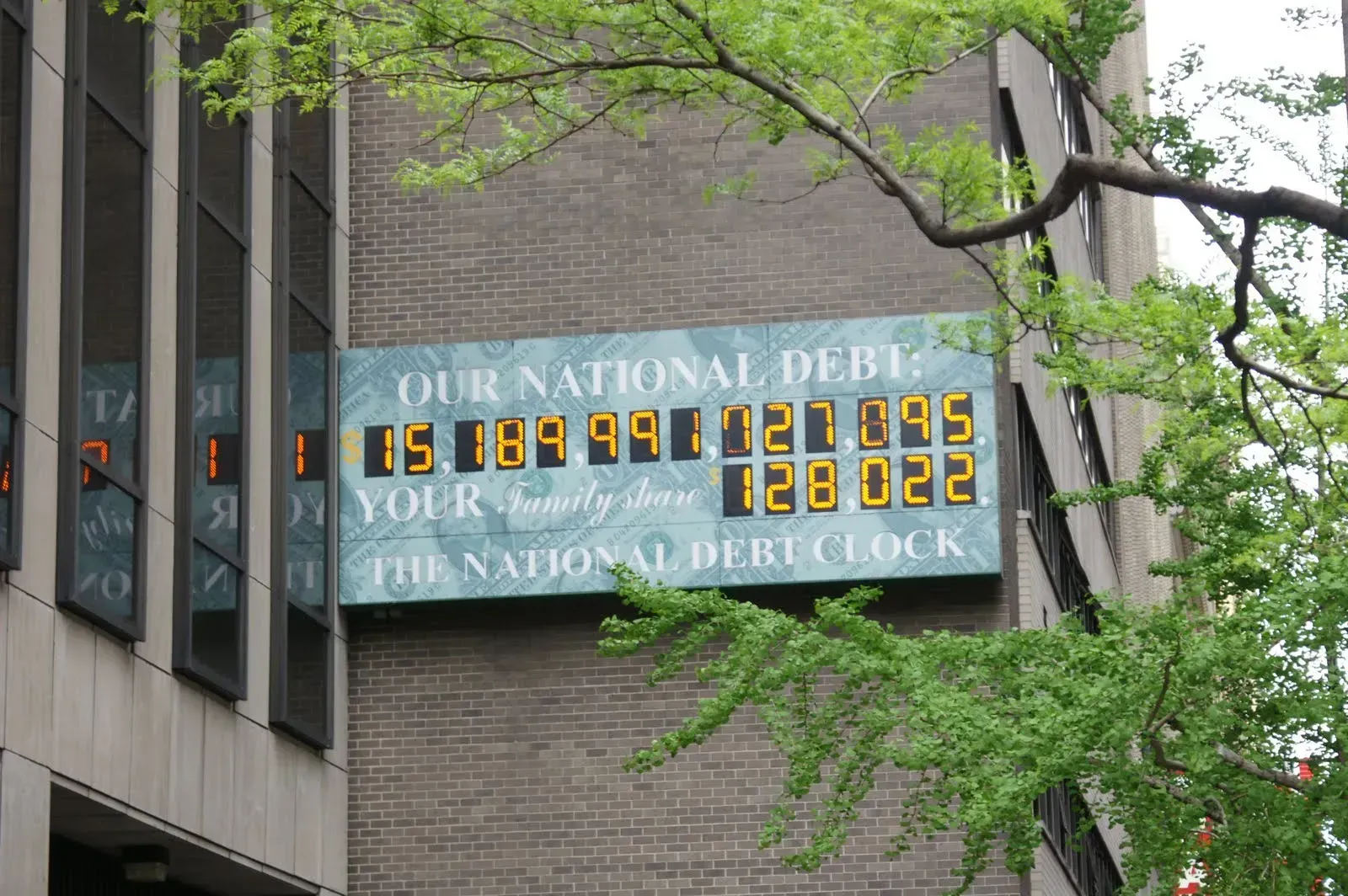
If the Supreme Court rules with lower courts that a large share of the President’s tariffs are illegal and policymakers extend various expiring or expired provisions, deficits could reach $3.8 trillion in 2036 as opposed to $3.1 trillion, and debt could grow to 131% of GDP by 2036 as opposed to 120%. In this case, a debt spiral would be far more likely and the risk of a fiscal crisis would grow.
There’s genuine uncertainty hanging over the revenue assumptions. A decision from the high court on Trump’s ability to impose his global tariffs under the International Emergency Economic Powers Act could come later this month. If those tariffs disappear, so does a substantial portion of assumed federal revenue offsetting other spending increases.
CRFB warned the actual fiscal outlook could be far worse than even the latest sobering projections. While booming revenue from Trump’s tariffs have helped mitigate deficits, they are on shaky legal ground. Financial markets are watching nervously.
Multiple Crisis Scenarios Loom Over Fiscal Trajectory

The United States national debt has reached 100% of GDP, placing the nation on a trajectory that could trigger six distinct types of fiscal crises according to the Committee for a Responsible Federal Budget. The nonpartisan watchdog’s report outlined a dangerous future ahead, noting that “if the national debt continues to grow faster than the economy, the country could ultimately experience a financial crisis, an inflation crisis, an austerity crisis, a currency crisis, a default crisis, a gradual crisis, or some combination of crises”.
Interest costs on the debt surged to roughly $1 trillion last year, consuming a near record 18% of federal revenue, an amount comparable to the entire Medicare budget. That’s money that can’t be used for anything else. With debt at 100% of GDP, the U.S. has less fiscal space than any time in history in case of another war, pandemic, or recession.
The CRFB noted that Western European economies such as France and the UK exhibit signs of a gradual crisis, with slow growth and inflexible fiscal policy, driven in part by high borrowing rates. The report noted that a crisis does not require a single tipping point but can be sparked by various catalysts, including a recession or a poor Treasury auction.
Interest Costs Now Exceeding Defense and Medicare Spending

In fiscal year 2024, federal net interest spending increased 14 percent from fiscal year 2023, from $658 billion to $882 billion. That was more than the government spent on national defense or Medicare. The shift in federal spending priorities is happening quietly but dramatically.
Relative to the size of the economy, interest costs would reach 3.3 percent of GDP in 2026, eclipsing the previous high set in 1991. Interest costs would climb to 4.6 percent of GDP by 2036. As a share of federal revenues, federal interest payments would rise to 18.6 percent this year, above the previous high set in 1991. Under CBO’s projections, that ratio would climb to 25.8 percent by 2036.
Honestly, when a quarter of everything the government collects goes just to pay interest, you’ve got a problem. Mounting interest costs put tremendous pressure on the federal budget, making it more difficult and costly to address pressing challenges and invest for the future. Future generations will look back at these decisions with bewilderment.
Economic Growth Effects From Rising Debt Burden
CBO’s baseline assumes that for every new dollar of government borrowing, private investment falls by 33 cents. After incorporating the effects of the crowd out phenomenon, average income would increase by just $41,900 in calendar year 2055, from $89,900 in CY 2025 to $131,800 in CY 2055. Rising debt under current law would reduce income growth by 16 percent and reduce income in CY 2055 by nearly 6 percent.
This crowding out effect is real and measurable. When government borrows more, it competes with private businesses for investment capital. The rising debt leads to growing interest costs, which threaten to crowd out opportunities for investment in other important priorities in both the public and private sectors. Think of it as the government outbidding entrepreneurs for the available pool of savings.
Risks include slower economic growth and increased chances of a fiscal crisis. The math is unforgiving. High debt levels constrain economic potential while simultaneously increasing vulnerability to external shocks.
Political and Policy Drivers Behind Accelerating Debt

The One Big Beautiful Bill is expected to add $4.7 trillion to deficits over the next decade, despite some offsetting effects from Trump’s tariffs, which may reduce deficits by $3 trillion. The 2025 reconciliation act and administrative actions related to immigration increased CBO’s projections of deficits after changes in the economy and related debt service costs are accounted for.
The largest single contributor is the 2025 reconciliation act, which permanently extended the individual income tax rates and business investment incentives originally established by the 2017 tax act. Tax cuts without corresponding spending reductions inevitably widen deficits. The primary deficit, the gap between program spending and revenue, was about $950 billion in fiscal year 2024. Net interest spending was about $882 billion in fiscal year 2024.
Projected increases in spending for Medicare, other federal health care, and Social Security programs compared to relatively lower projected increases in revenue drive the structural imbalance. These are not problems that disappear with economic growth alone.
Uncertain Path Forward Demands Difficult Policy Choices

CBO Director Phillip Swagel said in a statement that “our budget projections continue to indicate that the fiscal trajectory is not sustainable”. Congress and the administration will need to make difficult budgetary and policy decisions to address persistent deficits and reduce the nation’s borrowing needs. The sooner the federal government takes action to address the nation’s fiscal outlook, the less drastic those efforts will need to be. GAO continues to recommend that Congress and the administration develop a strategy for fiscal sustainability.
The United States has successfully reduced massive debt burdens before. In 1946, after borrowing heavily to fund World War II efforts, federal debt reached 106 percent of GDP. From 1946 to 1974, the United States reduced its debt burden from 106 percent down to 23 percent of GDP through a combination of fiscal restraint and fast economic growth.
I know it sounds crazy, but the solutions exist. They’re just politically painful. A more robust approach to get debt back down to 23 percent of GDP will be a combination of lower and more efficient spending, higher revenues, and faster growth. Unfortunately, none of those options poll particularly well.
The question facing America isn’t whether action is needed. The data makes that abundantly clear. The question is whether policymakers will act before markets force their hand. Because when borrowing costs start exceeding economic growth in a country carrying debt equal to its entire annual output, the margin for error vanishes quickly. What do you think it will take to change course? The window for gradual adjustment is closing fast.