The Lost Art of Letting Ideas Develop Slowly
There’s a particular kind of impatience that defines how we treat ideas today. We generate them fast, share them faster, and move on before they’ve had any real chance to breathe. The expectation seems to be that a good idea should announce itself loudly and immediately – fully formed, ready to present, ready to act on.
That’s not how most good ideas actually work. History suggests the opposite: that the best thinking tends to require time, drift, and a willingness to let things remain unresolved. The science now backs this up in ways that are hard to ignore.
The Myth of the Eureka Moment

Although in retrospect great discoveries may seem like single, definable eureka moments, in reality they tend to fade into view slowly – like gradually maturing slow hunches, which demand time and cultivation to bloom. Darwin’s theory of natural selection is perhaps the most famous example. According to Darwin himself, the theory simply popped into his head when contemplating Malthus’ writings on population growth. His notebooks, however, reveal that far before this so-called epiphany, he had already described a very nearly complete theory of natural selection – a slow hunch that only matured into a fully-formed theory over time.
Similarly, Tim Berners-Lee didn’t invent the World Wide Web in a singular moment of inspiration. His development efforts were a side project, proceeding in his spare time over a period of five years. At first the project was nebulous and vague, but the idea matured slowly – a slow hunch that blossomed into a true innovation over time. These examples aren’t outliers. They describe how most serious breakthroughs actually happen.
What Incubation Really Means

The process of creative problem solving consists of several stages: it starts with the discovery of the problem, followed by the generation of ideas, incubation, evaluation of the ideas, selection of the appropriate solution, and then elaboration of the selected outcome. That middle stage – incubation – is the one we’re most likely to skip. We go from idea to evaluation almost instantly, skipping the period during which the idea might actually develop into something.
Research supports the idea that it is not merely the absence of conscious thought that drives incubation effects, but that during an incubation period, unconscious processes actively contribute to creative thinking. Multiple studies suggest that taking breaks from creative problem solving – these incubation periods – enhances subsequent performance, possibly due to mind wandering during these breaks. Stepping away, in other words, isn’t procrastination. It’s part of the work.
How the Distracted Mind Actually Helps

The dual pathway to creativity model suggests that mind wandering can enhance creative performance through the cognitive flexibility pathway. This is a meaningful distinction. The kind of thinking that produces new connections isn’t the same kind that helps you concentrate on a spreadsheet. Research finds that mind wandering significantly enhances creativity performance in individuals, particularly under low cognitive load conditions.
Higher creative individuals can more easily draw connections between unexpected or distantly related ideas. The richer, more flexible semantic memory structure exhibited in highly creative individuals has been shown to facilitate broader search processes. This kind of associative reach doesn’t happen under pressure or on a deadline. It happens in the gaps – during a walk, in the shower, in the quiet stretch between tasks.
What Sleep Does That Waking Thought Cannot

Research proposes that REM and non-REM sleep facilitate creativity in different ways. Memory replay mechanisms in non-REM sleep can abstract rules from large bodies of learned information, while replay in REM may promote novel associations. The iterative interleaving of REM and non-REM across a night boosts the formation of complex knowledge frameworks, and allows these frameworks to be restructured – facilitating creative thought.
It is well-known that the chances of being struck by a creative insight can be increased by sleeping on a problem. Research has demonstrated that when puzzles were incorporated into REM-sleep dreams, they were more likely to be solved the next morning. The brain continues to process unresolved problems even when you’re not consciously attending to them. This is not a metaphor. It’s a measurable neurological process.
The Attention Collapse That Makes Slow Thinking Harder

Gloria Mark, a professor of informatics at the University of California, Irvine, has been measuring how long people sustain attention on a single screen for nearly two decades. Her research reveals a dramatic and accelerating decline: in 2004, the average attention span on any given screen was two and a half minutes. By 2012, it had fallen to 75 seconds. Her most recent measurements place the average at just 47 seconds.
This “context switching” – the constant shifting of focus across different content – prevents the brain from entering a flow state, the deep immersive focus required for mastery and creativity. Frequent exposure to rapid stimuli trains the brain to expect information in short bursts, making any task requiring more than a minute of focus feel like a significant obstacle. Surveys have found that roughly half of adults believe “deep thinking” has become a thing of the past.
The Slow Hunch and Why We Keep Abandoning It

Most great ideas first take shape in a partial, incomplete form. They have the seeds of something profound, but they lack a key element that can turn the hunch into something truly powerful. More often than not, that missing element is somewhere else, living as another hunch in another person’s head. The problem is we rarely allow these partial ideas to linger long enough to complete themselves.
Most slow hunches never last long enough to turn into something useful, because they pass in and out of memory too quickly, precisely because they possess a certain murkiness. You get a feeling that there’s an interesting avenue to explore, but then get distracted by more pressing matters and the hunch disappears. We mistake that murkiness for a sign the idea isn’t good enough, when it may simply mean the idea isn’t done yet.
How AI Is Accelerating the Problem

Large language models are now central to the ideation phase, where possibilities are explored and assumptions are challenged. Their adoption for idea generation and brainstorming has surged, making these activities among the most common uses in organizations. This has practical value. It also carries a risk that’s easy to overlook.
While individuals may generate more original ideas with AI assistance, the overall diversity across groups can narrow, making ideas more similar. When a tool can produce dozens of ideas in seconds, the pressure to sit with one idea long enough for it to develop into something distinctive can feel unnecessary. Speed and volume become substitutes for depth – a trade-off that may look productive but quietly drains originality from the process.
What Semantic Memory Has to Do With It
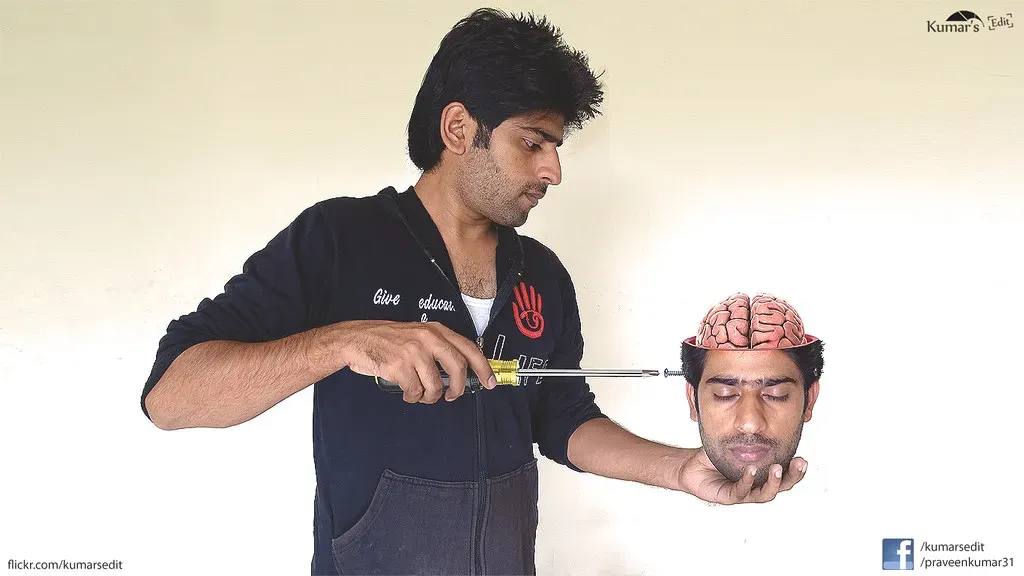
Creative block is related to “being stuck,” and semantic memory may play a critical role in such phenomena. Semantic memory – the cognitive system that stores facts and knowledge – plays a central role in creative ideation. The associative theory of creativity holds that creativity is related to the ability to form associations between distant or unrelated concepts in semantic memory.
Evidence that the way we traverse through memory systems is related to creativity suggests that semantic memory networks can be utilized to elicit creative ideation. In practical terms, this means that ideas benefit from exposure to other ideas – especially distant, unrelated ones. Time spent reading widely, thinking loosely, or simply letting the mind wander across different domains isn’t wasted. It’s the raw material that allows surprising connections to form.
Practical Conditions That Let Ideas Mature

The narrative of the “Eureka moment” is seldom accurate. More often than not, innovation occurs once a slow hunch has reached maturity. Slow hunches can reach maturity by colliding with other ideas. Keeping one’s slow hunches alive is therefore advisable, and keeping a commonplace book – a running record of thoughts, observations, and fragments – is an excellent way to cultivate and sustain them.
Practices that strengthen focus – including meditation – help the brain learn to notice and use boredom productively. This trains the brain to take moments of stillness and use them to develop imaginative thinking, slowly building the capacity to let ideas bloom in quiet rather than reaching for immediate stimulation. The conditions for slow thinking are not mysterious. They require protecting time from interruption and resisting the impulse to resolve every thought before it’s ready.
Why Depth Still Matters in 2026

Scientific research demands sustained focus, patience, and the ability to wrestle with complex problems over long periods. If younger generations are increasingly wired for distraction, we risk a future where fewer individuals possess the cognitive stamina required for breakthroughs in fields like medicine, climate science, and artificial intelligence. This isn’t a warning about attention spans in the abstract. It’s a statement about what slow thinking actually produces.
Research from Asana found that roughly three-fifths of knowledge workers’ time is consumed by what they call “work about work” – communicating about tasks, switching between applications, managing competing priorities. Only about two-fifths is spent on the skilled, strategic, or creative work these individuals were hired to do. The conditions for fast, fragmented thinking are well-designed. The conditions for slow, generative thinking still have to be deliberately built.
The ideas most worth having are rarely the ones that arrive first. They tend to be the ones that survive long enough to become something more than a first impression – shaped by time, interrupted thought, and the strange, quiet work that happens when we finally stop rushing them.