Forbidden History: 4 Artifacts Found in Places They “Shouldn’t” Exist
Every so often, archaeology throws a wrench into the tidy narrative of human progress. These are the objects that make experts pause, the ones that surface in locations or time periods where they simply have no business being. They challenge our assumptions, rewrite timelines, and raise uncomfortable questions about just how advanced, connected, and inventive ancient people really were. Here are four of the most compelling examples, each backed by real research, each still igniting debate.
1. The Antikythera Mechanism: A Computer That Arrived 1,500 Years Too Early
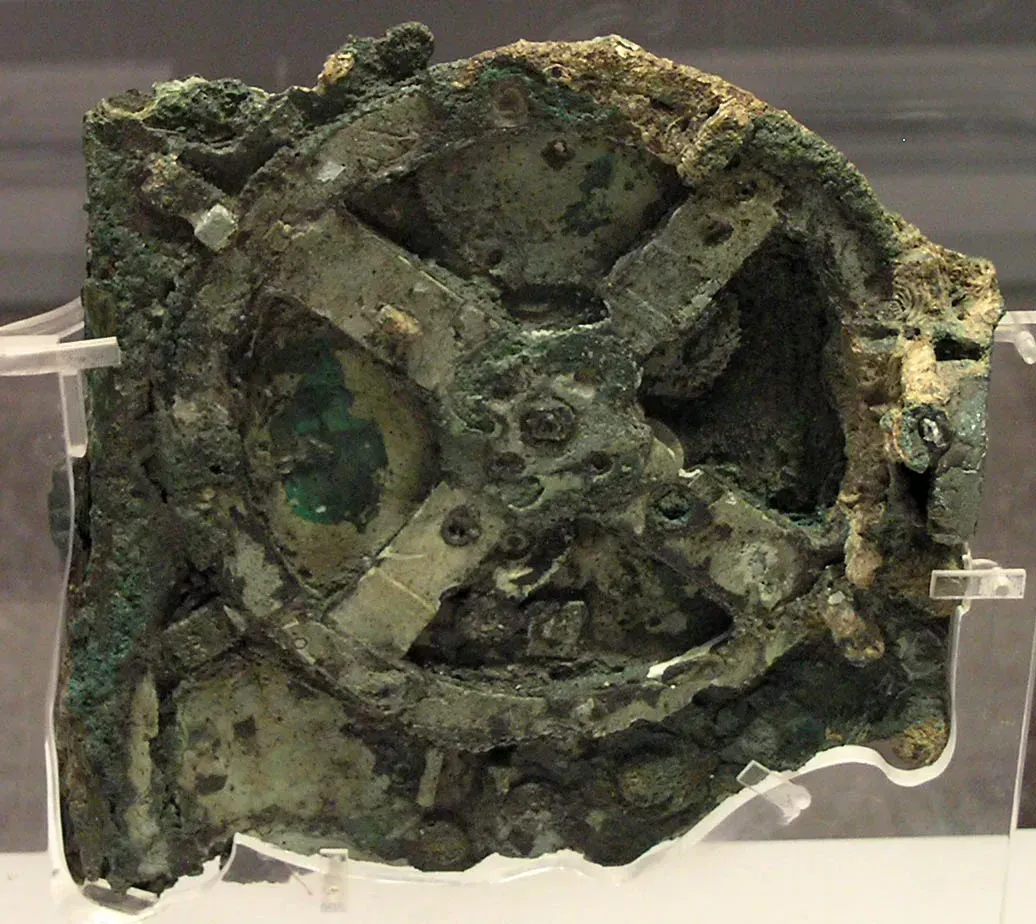
The Antikythera mechanism, discovered in 1901 by sponge divers exploring a sunken shipwreck off the Greek island of Antikythera, dates back approximately 2,200 years. This shoebox-sized device, constructed of intricate bronze gears, was used to model the motions of the sun, moon, and planets. Over decades, researchers have determined that the mechanism functioned as a hand-operated mechanical computer, allowing users to predict eclipses and calculate astronomical positions with remarkable accuracy for its time. The sheer existence of such a device in the ancient world remains, by almost any measure, one of archaeology’s greatest puzzles.
Machines with similar complexity did not appear again until the 14th century in western Europe. In 2024, researchers from the University of Glasgow published a landmark paper in the Horological Journal that used statistical modeling techniques normally applied to gravitational wave analysis to decode one of the mechanism’s broken rings. They showed that the ring is vastly more likely to have had 354 holes, corresponding to the lunar calendar, than 365 holes, which would have followed the Egyptian calendar. The analysis also shows that 354 holes is hundreds of times more probable than a 360-hole ring, which previous research had suggested as a possible count. Adding yet another layer of intrigue, in 2025, one research team concluded that manufacture error in the original mechanism’s gears is too great for the mechanism to have ever worked, though they emphasized that the scans they used could be incorrect about the extent of imperfections.
2. The Baghdad Battery: Ancient Electricity or Sacred Jar?
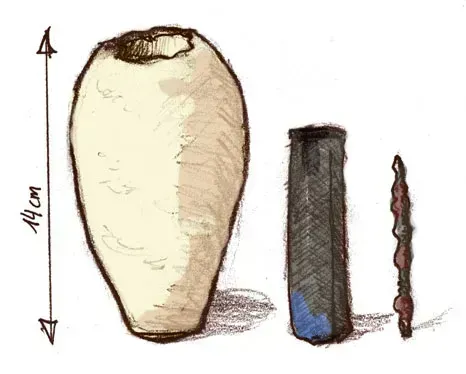
The Baghdad Battery is the name given to an artifact consisting of a ceramic pot, a tube of copper, and a rod of iron fixed together with bitumen. It was discovered in present-day Khujut Rabu, Iraq in 1936, close to the ancient city of Ctesiphon, the capital of the Parthian and Sasanian empires, and it is believed to date from either of these periods. Wilhelm König, at the time director of the laboratory of the National Museum of Iraq, suggested that the object functioned as a galvanic cell, possibly used for electroplating, or some kind of electrotherapy. That single suggestion set off a debate that has refused to die for nearly a century.
A new study highlighted by Chemistry World purports that the Baghdad Battery wasn’t just a battery, but one capable of outputting much more power than once believed. Independent researcher Alexander Bazes proposed that the jar’s porous clay exterior acted as a separator between an electrolyte and air, creating an outer cell alongside the inner iron rod. University of Pennsylvania archaeologist William Hafford, who has extensively researched the artifact, counters that it was likely a sacred jar for storing prayers, noting that other magic items like it have been found buried nearby, including a similar clay jar with ten copper vessels – obviously too many to form a battery. There is no electroplated object known from this period, and the claims are universally rejected by archaeologists. The artifact itself, tragically, was discovered in 1936 but has since been lost following the US-led invasion of Iraq in 2003, making definitive testing impossible.
3. Stonehenge’s Altar Stone: A Scottish Giant in an English Field

Lying flat at the heart of Stonehenge, the six-tonne, five-metre-long rectangular Altar Stone is a grey-green sandstone, far bigger and different in its composition from the other bluestones. For over a century, scientists assumed it had been dragged from Wales, a journey already staggering enough for Neolithic people. Then, in August 2024, a study published in the journal Nature turned that assumption entirely on its head. Mineral ages and chemical analysis of fragments of the Altar Stone suggest that it was transported from northeast Scotland, more than 750 km away, probably by sea.
With its origin in the Orcadian Basin, the Altar Stone has traveled a remarkably long distance – a straight-line distance of at least 700 kilometers. This is the longest-known journey for any stone used in a Neolithic monument. Transporting such massive cargo overland from Scotland to southern England would have been extremely challenging, indicating a likely marine shipping route along the coast of Britain. This implies long-distance trade networks and a higher level of societal organisation than is widely understood to have existed during the Neolithic period in Britain. This is an incredible distance for Neolithic times, before the wheel is thought to have arrived in Britain. The question of precisely how and why it was moved there remains entirely open, and researchers are still working to narrow down its exact Scottish source.
4. The 51,200-Year-Old Cave Art of Sulawesi: Narrative Painting Before “Modern” Cognition
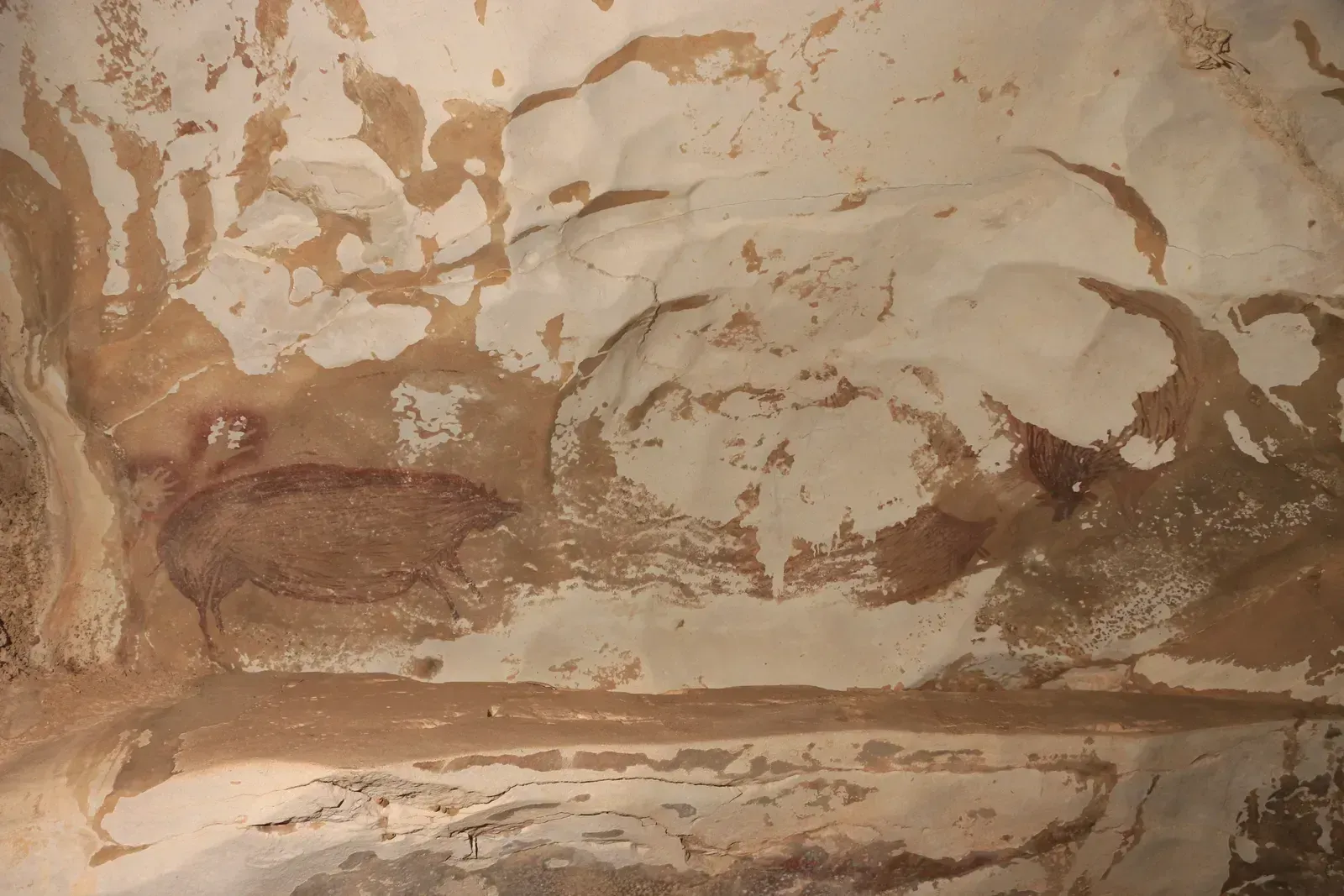
Scientists announced in 2024 that a painted scene of people hunting pig-like animals found in a cave on the island of Sulawesi, Indonesia, is at least 51,200 years old. This beats out the last contender for oldest cave art, a drawing of pigs also found in a cave in Indonesia, by around 5,000 years. What makes this discovery especially disruptive is not just the age, but the content: it is a narrative scene, depicting humans in coordinated action, at a point in prehistory when scientists had not expected such complex symbolic thought to exist in that region.
The find challenges the long-held assumption that sophisticated storytelling through visual art originated in Europe. Instead, it places the birthplace of narrative image-making squarely in Southeast Asia, tens of thousands of years earlier than conventional models of cognitive evolution had allowed for. All Bronze Age boats so far had been discovered near the coast, which led archaeologists to think that ancient Mediterranean seafarers stuck near land. But newer discoveries suggest they may have been more adventurous, using the stars to navigate in deep water far from the coast. Together, these findings paint a picture of ancient humans who were far more capable, far more connected, and far more creative than textbooks have traditionally suggested. The Sulawesi cave art stands as quiet, painted proof that imagination did not arrive on a fixed schedule.